Difference Between Pushdown Automata and Finite Automata
Last Updated :
12 Jul, 2025
Pushdown Automata (PDA) and Finite Automata (FA) are two important computational models in automata theory that are used to recognize different classes of languages. Both models process the input strings and transition between states based on predefined set of rules. The key difference between them lies in their memory capabilities.
- A Finite Automaton has no external memory and is limited to recognizing regular languages.
- A Pushdown Automata is equipped with a stack which allows it to manage more complex memory operations.
What is Pushdown Automata
A Pushdown Automaton (PDA) is a type of automaton that includes a stack to provide additional memory beyond what is available in a finite automaton. This extra memory allows the PDA to recognize a broader class of languages-specifically, context-free languages. Pushdown Automata are commonly used to model situations where a system needs to remember an unbounded amount of data in a Last-In, First-Out (LIFO) manner.
Unlike Finite Automata, PDAs can be non-deterministic, enabling them to explore multiple computational paths simultaneously. It utilizes stack to manage and track these computational paths. As they process input strings, PDAs store symbols on their stack and can push or pop these symbols in response to state transitions, making them powerful tools for tasks like syntax parsing in compilers.
It contains the following 7 tuples:
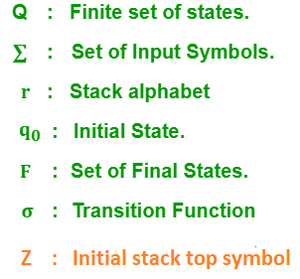 Tuples in Pushdown Automata
Advantages of Pushdown Automata
- Memory Management: PDAs can handle context-free languages (CFLs) effectively due to their use of a stack, which provides dynamic memory in a Last-In, First-Out (LIFO) manner.
- Recognition of Complex Languages: Context-free languages are more sophisticated than regular languages, and PDAs are specifically designed to recognize and process them.
- Effective for Parsing: PDAs are highly effective in parsing expressions in programming languages, making them essential tools in compiler design and syntax analysis.
Disadvantages of Pushdown Automata
- Restricted Memory Management: Although PDAs have a stack for memory, its use is limited to Last-In, First-Out (LIFO) operations, which restricts the type of memory management they can perform.
- Increased Complexity: The addition of a stack makes PDAs more complex to design and analyze compared to Finite Automata, requiring more effort to model and verify behavior.
- Limited Language Recognition: PDAs are confined to recognizing context-free languages and are incapable of processing more complex language classes such as context-sensitive or recursively enumerable languages.
What is Finite Automata
A Finite Automaton (FA) is a simpler computational model used for recognizing regular languages. Unlike a Pushdown Automaton (PDA), an FA does not have access to additional memory, meaning it can only remember a finite amount of information at any given time. Finite Automata transition between states based on input symbols and predefined state transitions. They can be either Deterministic (DFA) or Non-Deterministic (NFA), depending on whether each input leads to a unique next state or multiple possible states.
The key feature of a Finite Automaton is its lack of a memory structure like a stack; its computation depends solely on the current state and the current input symbol, making it suitable for simpler language recognition tasks such as pattern matching and lexical analysis.
It contains the following 5 tuples:
 Tuples in Finite Automata
Advantages of Finite Automata
- Simplicity: Finite Automata are easy to design, understand, and implement, making them ideal for teaching, learning, and practical applications like lexical analysis.
- Efficiency: FAs operate with linear time complexity relative to the size of the input, making them highly efficient for recognizing regular languages.
- Determinism (in DFAs): Deterministic Finite Automata (DFAs) exhibit predictable and consistent behavior, as each input symbol leads to exactly one possible next state.
Disadvantages of Finite Automata
- Limited Language Recognition: FAs can only recognize regular languages, which are the simplest class of languages in the Chomsky hierarchy.
- No Memory: Finite automata lack memory beyond their current state, making them incapable of recognizing more complex languages like context-free languages.
Difference Between Pushdown Automata and Finite Automata
Feature | Pushdown Automata (PDA) | Finite Automata (FA) |
|---|
Memory | Utilizes a stack for memory | No memory component; only tracks the current state |
Language Recognition | Recognizes Context-Free Languages | Recognizes Regular Languages |
Memory Operations | Can push, pop, or read symbols from the stack | No memory operations; transitions are state-based |
Components | 7-tuple (includes stack) | 5-tuple (no stack) |
Transition Function | Depends on the current state, input symbol, and stack | Depends only on the current state and input symbol |
Computational Power | More powerful due to stack memory | Less powerful , can only recognize simpler languages |
Use Case | Parsing programming languages, handling nested structures | Pattern matching, lexical analysis |
Complexity | More complex to design and analyze | Simpler to design and analyze |
Example | Recognizes languages like palindromes | Recognizes languages like basic string patterns (e.g., ab) |
Explore
Automata _ Introduction
Regular Expression and Finite Automata
CFG
PDA (Pushdown Automata)
Introduction of Pushdown Automata
5 min read
Pushdown Automata Acceptance by Final State
4 min read
Construct Pushdown Automata for given languages
4 min read
Construct Pushdown Automata for all length palindrome
6 min read
Detailed Study of PushDown Automata
3 min read
NPDA for accepting the language L = {anbm cn | m,n>=1}
2 min read
NPDA for accepting the language L = {an bn cm | m,n>=1}
2 min read
NPDA for accepting the language L = {anbn | n>=1}
2 min read
NPDA for accepting the language L = {amb2m| m>=1}
2 min read
NPDA for accepting the language L = {am bn cp dq | m+n=p+q ; m,n,p,q>=1}
2 min read
Construct Pushdown automata for L = {0n1m2m3n | m,n ≥ 0}
3 min read
Construct Pushdown automata for L = {0n1m2n+m | m, n ≥ 0}
2 min read
NPDA for accepting the language L = {ambncm+n | m,n ≥ 1}
2 min read
NPDA for accepting the language L = {amb(m+n)cn| m,n ≥ 1}
3 min read
NPDA for accepting the language L = {a2mb3m|m>=1}
2 min read
NPDA for accepting the language L = {amb2m+1 | m ≥ 1}
2 min read
NPDA for accepting the language L = {aibjckdl | i==k or j==l,i>=1,j>=1}
3 min read
Construct Pushdown automata for L = {a2mc4ndnbm | m,n ≥ 0}
3 min read
NPDA for L = {0i1j2k | i==j or j==k ; i , j , k >= 1}
2 min read
NPDA for accepting the language L = {anb2n| n>=1} U {anbn| n>=1}
2 min read
NPDA for the language L ={wЄ{a,b}* | w contains equal no. of a's and b's}
3 min read
Turing Machine
Decidability
TOC Interview preparation
TOC Quiz and PYQ's in TOC