
Arithmetic Progression is a sequence of numbers where the difference between any two successive numbers is constant. For example 1, 3, 5, 7, 9……. is in a series which has a common difference (3 – 1) between two successive terms is equal to 2. If we take natural numbers as an example of series 1, 2, 3, 4… then the common difference (2 – 1) between the two successive terms is equal to 1.
Table of Content
- What is an Arithmetic Progression?
- Finding the Formula for Arithmetic Progression
- Applying Arithmetic Progression to Divisibility
- Solving a Sequence word problem using AP
- Sum of First n Terms | Class 10 Maths
- Computing Sum of First n natural numbers
- Practice Problems - Sum of First n Terms | Class 10 Maths
What is an Arithmetic Progression?
An Arithmetic Progression (AP) or arithmetic series is a sequence of numbers such that the difference between any two consecutive numbers (or terms) is a constant value.
Examples of Arithmetic Progression
Sequence 1: 1, 2, 3, 4, 5, 6, ... The above sequence forms an AP since the difference between any two consecutive terms is the same, which is equal to 1. See below:- 2 - 1 = 1 (2nd - 1st) 3 - 2 = 1 (3rd - 2nd) ... 6 - 5 = 1 (6th - 5th)
Sequence 2: -4, -2, 0, 2, 4, 6, ... Similarly, the above sequence also forms an AP:- (-2) - (-4) = 2 (2nd - 1st) (0) - (-2) = 2 (3rd - 2nd) ... 6 - 4 = 2 (6th - 5th)
Sequence 3: 1, 3, 5, 9, 4, 10, ... The above sequence doesn't form an AP as the difference between any two consecutive terms are not the same:- 3 - 1 = 2 5 - 3 = 2 9 - 5 = 4 4 - 9 = -5 10 - 4 = 6
Finding the Formula for Arithmetic Progression
From the examples given above, can you spot the pattern? How can we find the nth term for any provided n?
Let's try to find out the pattern. Look again at Sequence 2:-
Sequence 2: -4, -2, 0, 2, 4, 6, ... We see difference as (-2) - (-4) = 2 = ...= 6 - 4 = 2. So difference (say) d = 2. 1st term (say) a = -4
We can write all the terms as:
1st: -4 + (0) × 2
2nd: -4 + (1) × 2
3rd: -4 + (2) × 2
4th: -4 + (3) × 2
....
....
nth: -4 + (n - 1) × 2
So we see if a is the first term and d is the difference then any nth term, say Tn can be calculated as:
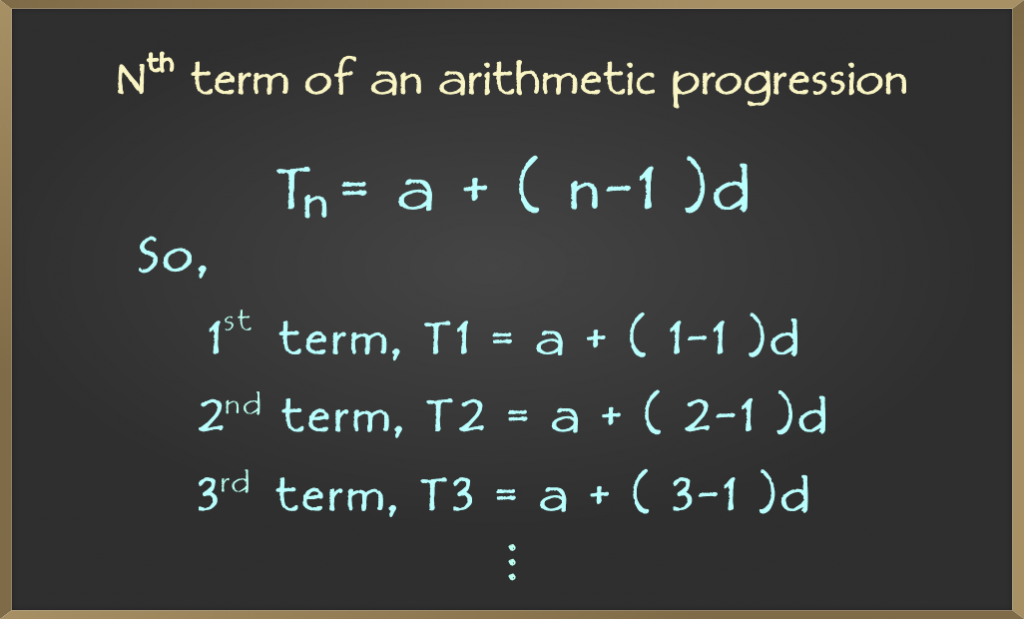
Let's now calculate the 100th term, so for n = 100, we have:
Tn = a + (n - 1) × d T100 = (-4) + (100 - 1) × 2 T100 = (-4) + (99) × 2 T100 = 194
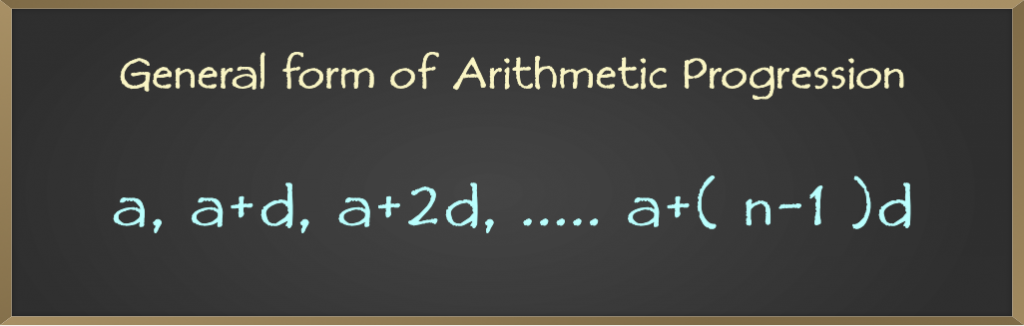
So an AP is of the form:
Applying Arithmetic Progression to Divisibility
Arithmetic Progression helps in making mathematical computations easy. Consider the following question:
Question: How many numbers are divisible by 3 in the range of 20 to 100?
Solution:
We can use our concept of AP here to solve the problem as follows:
Step 1: Calculate the first number divisible by 3 in the given range:
20 = 3 × 6 + 2 a = 20 + (3 - remainder) a = 20 + (3 - 2) a = 21
Step 2: Calculate the Last number (nth) in the given range:-
100 = 3 × 33 + 1 Tn = 100 - remainder Tn = 100 - 1 Tn = 99,.
So we have now an AP whose first term is a and the last term is Tn as follows:
21, 24, 27, ..., 99Now we need to find the number of terms in the above AP, so we use our formula for the nth term for an AP:
Tn = a + (n - 1) × d
a = 21, Tn = 99, d = 3
99 = 21 + (n - 1) 3
n = 27Hence, there are 27 numbers between 20 and 100 that are divisible by 3.
Solving a Sequence word problem using AP
These types of problems consist of finding a rule (AP formula) for the sequence given in the problem. These are fairly easy.
Consider the following problem:
Problem: What equation describe the growth pattern of following sequence of numbers:
1, 5, 9, 13, ....
Also calculate 41th term?
Solution:
Let's see if the sequence follows an AP if any and try to find out the first term and difference:
5 - 1 = 4
9 - 5 = 4
13 - 9 = 4So the difference between any two consecutive terms is the same (equal to 4) so it forms an AP:
Tn = 1 + (n - 1) × 4
So the growth pattern is 1 + (n - 1) × 4 and the 41st term is :
T41 = 1 + (41 - 1) × 4
T41 = 161
Sum of First n Terms | Class 10 Maths
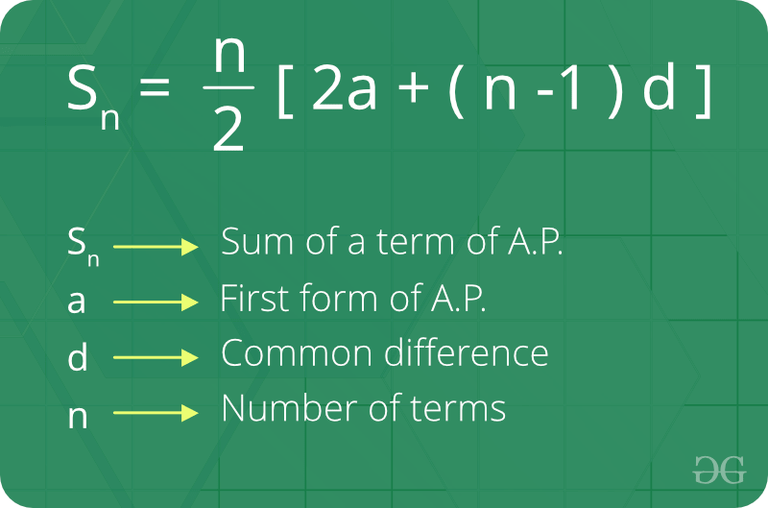
Given n and an AP, how do we calculate the sum of the first n terms? Let's derive the formula for it:
Let Sn denote the sum for the first n terms, we can write Sn in two ways:
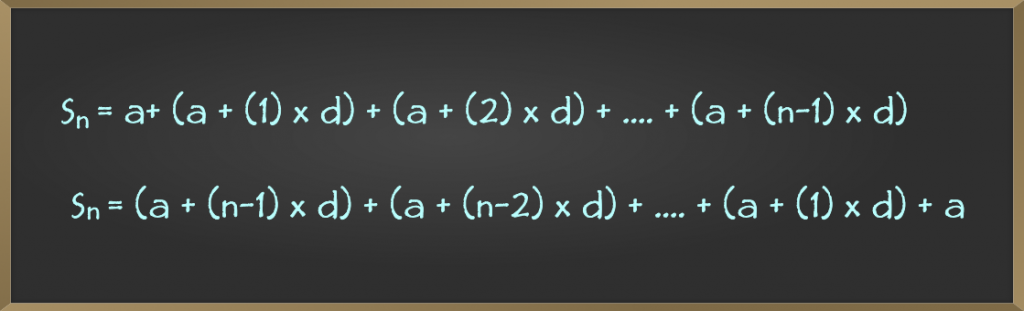
You see both are the same but written in opposite directions, i.e. in the first elements are from the first term to the last term, and in the second the elements are from last to first.
Now add the above two:-
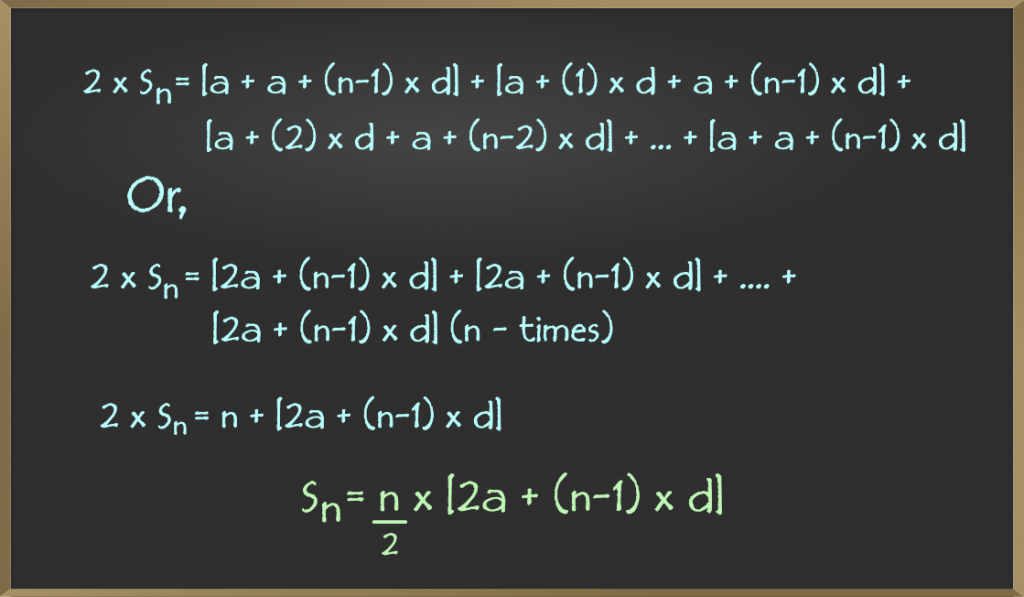
Computing Sum of First n natural numbers
Problem: Calculate the sum of natural numbers from 1 to 100.
According to anecdotes, when Gauss was in primary school, he was punished by his teacher due to misbehavior. Gauss was told to add the numbers from 1 to 100 (the teacher gave that considering that a tedious job). But he was able to compute its sum, which is 5050, in a matter of seconds. How did he do?
He did something like: 1 + 2 + 3 + . . . . + 49 + 50 + (100 - 49) + . . . . + (100 - 2) + (100 - 1) + 100
Which cancels out to 49 * 100 + 100 + 50 = 50 * 100 + 50 = 50(100 + 1). Gauss was great, but we aren't less though, since we have our formula, we will use that.
Solution:
We see the natural numbers (1, 2, 3, ...) form an AP and hence we can calculate the sum of the first n terms as follows:
First-term, a = 1
Difference, d = 1
So,Sn = (n/2) × [2a + (n - 1) × d]
Sn = (n/2) × [2 × 1 + (n - 1) × 1]
Sn = (n/2) × (n + 1)For n = 100, we have:
S100 = (100/2) × (100 + 1)
S100 = 5050
Practice Problems - Sum of First n Terms | Class 10 Maths
Problem 1: Find the sum of the first 10 terms of an arithmetic progression where the first term a = 3 and the common difference d = 2.
Problem 2: If the sum of the first 15 terms of an AP is 180 and the first term is 5, find the common difference.
Problem 3: The sum of the first 20 terms of an AP is 530, and the last term is 45. Find the first term.
Problem 4: Determine the number of terms in an AP if the first term is 2, the last term is 32, and the sum of all terms is 290.
Problem 5: The sum of the first n terms of an AP is given by Sn = 3n2 - 2n. Find the first term and the common difference of this AP.