What Is Lifetime Value (LTV) in Product Management?
Last Updated :
23 Jul, 2025
Lifetime value represents the potential value of a customer for the whole life cycle of a business. This will be an important metric to be implemented by the product manager to know how much value is brought in by customer acquisition and retention. This metric will give the product manager information on investment he should put into campaigns, strategies for getting new customers, and product development based on priorities. This metric will therefore be very instrumental in optimizing customer acquisition cost and ensuring sustained growth. It can provide meaningful insight into the value derived from a customer over time and hence drives the way for improved customer satisfaction and loyalty.
What is Lifetime Value (LTV)?
Lifetime Value (LTV) is what the business will expect to reap in total revenues with respect to one customer during the whole of their relationship with the firm. It is among the key metrics used in determining the long-term value that a customer will provide to a business and thus gives information on strategy, customer acquisition, and customer retention.
Why is Knowing Your Customers’ Lifetime Value Important?
There are several reasons why you should care about your customers' lifetime value.
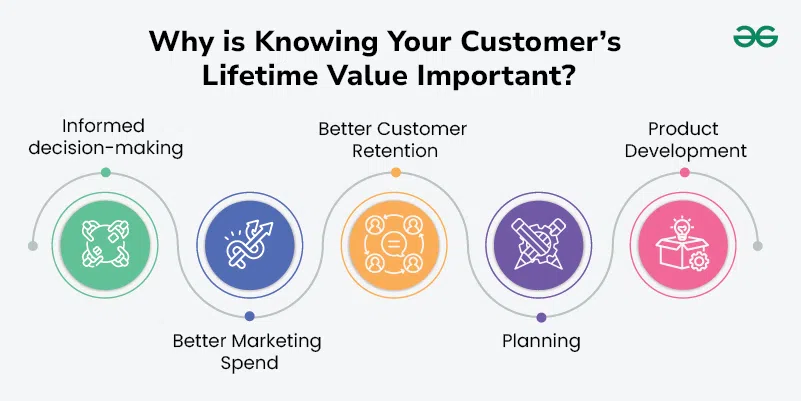 Why is Knowing Your Customers’ Lifetime Value Important
- Informed decision-making: LTV provides a view into the future profit of customer acquisition and retention. Knowledge of LTV allows businesses to decide on acquisition investments, retention strategies, and product investments in an informed manner.
- Better Marketing Spend: LTV allows a company to understand the maximum it can spend on a new customer such that they are profitable for the company. This allows for marketing budgets to be realistically set and, hence, customers can be acquired sustainably.
- Better Customer Retention: Understanding the value of different customer segments allows businesses to come up with better customer retention strategies. Such strategies should hold the interest of high-value customers who will be satisfied with the business.
- Planning: LTV helps a business predict revenues that are to come and see the way one can grow in the future by calculating a customer's lifetime value. It will also help efficiently approximate future cash flows, realistically set finance goals, and successfully develop operational scaling strategies.
- Product Development: LTV will guide the direction of new developments by pointing out the most valued features and improvements as conceived by the high-LTV customers. Thus, money put into a product investment goes to something that drives long-term customer satisfaction.
How Do You Calculate LTV?
Calculating LTV, in other words, is the total revenue that a business can derive from any individual customer over the entire lifetime of the relationship. There are several ways to calculate LTV, depending on the complexity of your business model and the kind of data you have. Here are some common methods:
A very simple general formula can be:
LTV = (0.10) × (Average Purchase Value) × (Average Purchase Frequency) × (Average Customer Lifespan)
- Average Purchase Value: This is simply the total revenue and the number of purchases in a given period.
- Average Purchase Frequency: This is the total number of purchases made in the period divided by the number of unique customers.
- Average Customer Life Span: it's how long a customer has on average to keep purchasing from your business, typically in years.
Example LTV Calculation:
- Average Purchase Value: $100
- Mean Purchase Frequency: 2 purchases per year
- Average Customer Lifespan: 5 years
- LTV = $100 × 2 × 5 = $1,000
If you like a more nuanced LTV because you are a profit-minder, you can use the Gross Margin:
LTV = (Average Revenue Per Customer) × (Gross Margin Percentage) × (Average Customer Lifespan)
- Average Revenue Per Customer = Total revenue / Number of customers
- Gross Margin Percentage = (Revenue - Cost of Goods Sold) / Revenue
- Average Customer Lifespan = defined earlier
Example Calculation
- Average Revenue Per Customer: $500
- Gross Margin Percentage: 60% (or 0.60)
- Average Customer Lifespan: 4 years
- LTV = $500 × 0.60 × 4 = $1,200
3. Cohort Analysis
For businesses where behavior tends to diverge significantly across customers, one can go up a level of granularity:
Segment Customers: Segment customers based on some similarity criteria (here, when did we first acquire them).
- Track Revenue: Track each cohort's revenue over time.
- Calculate LTV: Average revenue per cohort member to calculate LTV.
Example Calculation:
- Cohort A: Customers buying in January 2023, over its first year, led to a total revenue of $200,000.
- Cohort B: $180,000 for the first year of the February 2023 cohort
Average LTV across two January and February 2023 cohorts: ($200,000 + $180,000) / Number of customers in each cohort
Customer Lifetime Value Example Calculation
Below you can derive LTV:
LTV = Average Purchase Value × Average Purchase Frequency × Customer Lifespan
 Customer Lifetime Value Example Calculation
 Here is an example.
- Average Purchase Value: Let's say a customer generally buys a $50 worth of purchase.
- Average Purchase Frequency: A customer makes this kind of purchase 4 times a year on an average.
- Customer Lifespan: Generally an average customer stays with the business for a.
- LTV=50×4×5=1000
- This means the LTV of this customer is $1,000.
How Can You Increase Your Average Customer’s LTV?
Increasing the LTV of customers can drastically improve the profitability for any company. Some ways to go about doing this are as follows:
- Increase the customer retention rate: This will increase the lifetime value of each customer. Develop customer loyalty programs, personalized promotions, and excellent customer service to induce repeat buying.
- Increase the Frequency of Purchase: Offer subscription models or a newsletter to encourage consumers to buy more frequently. At the same time, create a moat of limited-time offers and promotions that will encourage a customer to come back earlier.
- Upsell and Cross-Sell: Offer the customer something that complements their purchase of closely related products or services. When suggesting higher-value items or simply making product bundles, you certainly have a chance to increase the average order value.
- Great Customer Experience: A good customer experience generally brings customers back. Make interaction easy, provide extraordinary support, and, most importantly, continuously ask for feedback for improvement.
- Personalization :Make use of your analytics data to recognize customer preferences and personalize communication and offers. Tailored marketing messages are more likely to drive repeat business.
- Develop quality products or services: Your products or services must fulfill or show above expectation of customers most of the time. In case they are satisfied, they most likely will go on with the same product and buy more rather than changing suppliers.
Why Does Customer Lifetime Value Matter?
LTV matters because it provides the important insights that are required for the long-term financial health and sustainability of a business. Here's why it's important:
- Guides marketing spend: Knowing LTV tells a company its affordability to pay for a new customer. Comparing that against the CAC, companies know that their marketing efforts are profitable. If LTV is far higher than CAC, then the company can justify increased customer acquisition spending.
- Focuses on Long-Term Profitability: LTV shifts focus away from short-term gains toward long-term customer relationships. LTV encourages investment in customer retention and loyalty programs, given that it is more profitable to retain old customers than to keep on acquiring new ones all the time.
- An analysis of LTV will help companies understand which customer segments are most valuable and, therefore, enhance their customer retention strategies. Grasping what makes high-value customers loyal can help align products, services, and experiences with customer relationships to help hold on to these customers and grow.
- Optimizes Product and Service Offerings: LTV data can underline which products or services will return the most customer retention and value. Businesses can then zero in on such offerings by fine-tuning them, adding new features, or retiring less profitable lines.
- Informs Business Strategy and Decision-Making: LTV provides the clear picture on return on investment from relationships with customers. It can help businesses in making investment decisions like their pricing strategy, product development, sales tactics, and where to concentrate on customer service.
Why Tracking LTV Used To Be So Difficult
Measuring Customer Lifetime Value has long been difficult because of a variety of challenges, most of which were created by technological limitations and data mismanagement. Why was tracking LTV so hard?
- Data Silos: Historically, customer data was recorded in various systems and parts of an organization, such as sales, marketing, and customer service. It is very hard to get a view of the interaction and transaction history of a customer in one view—something quite imperative for the calculation of LTV from these siloes.
- Limited data analytics tools: The companies did not have available sophisticated data analytics tools and software. These could easily bring together and analyze customer data. LTV tracking was inaccurate and inefficient, based on manual calculations or simple software.
- Inconsistent data quality: There was a lack of standardization across data entry and management processes; hence, inconsistency in the quality of customer data. This used to be incomplete, outdated, or inaccurate, and all of it impacted the ability to calculate LTV accurately and lead to unreliable insights.
- Nonintegrated Systems: Most businesses had standalone systems regarding different functions, including CRM, ERP, and marketing automation tools. The inability to integrate them makes the tracking of customer behavior, across multiple touchpoints and channels, tough to get a complete picture of customer value.
- Multichannel Customer Journeys: When customers began engaging with businesses across multiple channels—in-store, online, and social media—the tracking and true attribution of behaviors became very complicated. More sophisticated methods for understanding and quantifying the full engagement of customers over time became necessary.
- Time-Consuming Processes: It takes the tracking of purchases, average order values, purchase frequencies, and customer retention rates to arrive at an LTV. In case the systems are not automated, gathering and crunching this information will take so much time; hence, one could not track LTV regularly.
Conclusion
Knowing the Customer Lifetime Value in product management will give a complete view of the value the customer holds throughout their relationship with the company. Focusing on LTV, a Product Manager can drive data-induced decisions aimed at improving customer acquisition and retention strategies, drive the prioritization of product features to maximum value, and allocate resources more effectively. It sets the platform for long-term thinking, building great relationships with customers, and optimizing one's products for the long-term growth of the business. Among other key metrics, LTV helps product development goals to be fully aligned with the overall business goals. In other words, products would serve the evolving customer needs of those who are valuable while making a profit for the company.