
- Interview Prep
- Tutorials
- Tracks
Number Representation
Question 1
The decimal value 0.5 in IEEE single precision floating point representation has
fraction bits of 000…000 and exponent value of 0
fraction bits of 000…000 and exponent value of −1
fraction bits of 100…000 and exponent value of 0
no exact representation
Question 2
The smallest integer that can be represented by an 8-bit number in 2’s complement form is
-256
-128
-127
0
Question 3
P is a 16-bit signed integer. The 2's complement representation of P is (F87B)16.The 2's complement representation of 8*P
(C3D8)16
(187B)16
(F878)16
(987B)16
Question 5
(214.2)10 and (D6.8))16
(212.5)10 and (D6.8))16
(214.5)10 and (D6.8))16
(214.5)10 and (D6.4))16
Question 6
Consider the following state diagram and its realization by a JK flip flop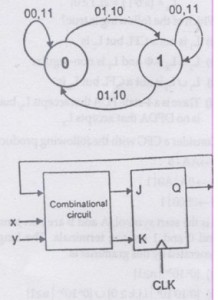
The combinational circuit generates J and K in terms of x, y and Q.
The Boolean expressions for J and K are :
(x⊕y)'and (x⊕y)'
(x⊕y)'and x⊕y
x⊕y and (x⊕y)'
x⊕yand x⊕y
Question 7
The number of 1's in the binary representation of (3*4096 + 15*256 + 5*16 + 3) are: ISRO 2015
8
9
10
12
Question 8
The range of integers that can be represented by an n bit 2’s complement number system is: ISRO 2015
- 2n - 1 to 2n - 1 - 1
- (2n - 1 - 1) to (2n - 1 - 1)
- 2n - 1 to 2n - 1
- (2n - 1 + 1) to (2n - 1 - 1)
Question 9
Which of the given number has its IEEE-754 32 bit floating point representation as 0 10000000 110 0000 0000 0000 0000 0000
2.5
3.0
3.5
4.5
Question 10
Which of the following binary number is the same as its 2's complement?
1010
0101
1000
1001
There are 87 questions to complete.