
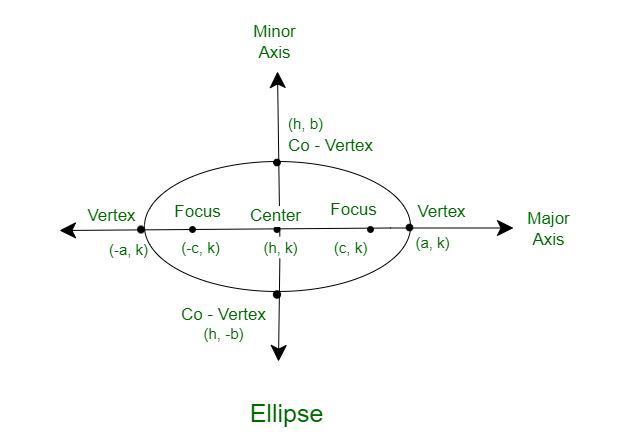
Answer: The standard equation of the ellipse whose centre is (h, k) is, \dfrac{(x-h)^2}{a^2}~+~\dfrac{(y-k)^2}{b^2}~=~1
Explanation:
A conic section can be defined as the set of points that describe the intersection of a right circular cone with a plane. The angle of intersection between the plane and the cone determines the shape of the conic section. When this angle is acute, that is, between 45° and 90°.
Alternatively, an ellipse can also be defined as such: a closed curve formed by a set of points whose sum of the distance from two fixed points is constant.
The standard equation of ellipse whose center is (h, k) is,
\dfrac{(x-h)^2}{a^2} + \dfrac{(y-k)^2}{b^2} = 1
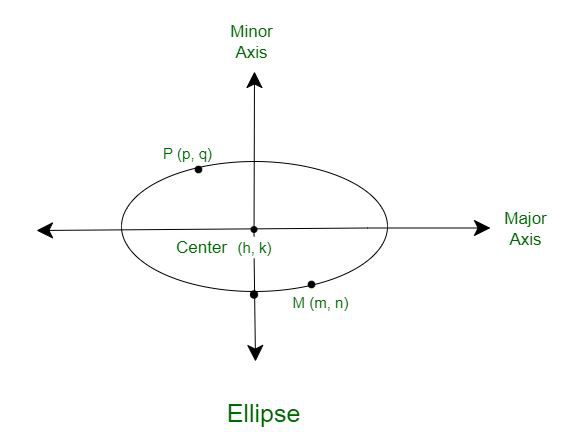
Question: Determine the equation of the standard form of the ellipse given: The coordinates of two points P (p, q) and M (m, n), and the coordinates of the center, O (h, k).
Solution:
It is known that the standard equation of the ellipse is,
\dfrac{(x-h)^2}{a^2} + \dfrac{(y-k)^2}{b^2} = 1 We have been provided the value of (h, k) in the question. Both P(p, q) and M(m, n) will satisfy the equation.
So, now we have two equations:
Equation 1:
\dfrac{(p-h)^2}{a^2} + \dfrac{(q-k)^2}{b^2} = 1 Equation 2:
\dfrac{(x-h)^2}{a^2} + \dfrac{(y-k)^2}{b^2} = 1 We can equate both the LHS of the equations (since the RHS is equal). Then, we get:
\dfrac{(p-h)^2}{a^2} + \dfrac{(q-k)^2}{b^2} = \dfrac{(m-h)^2}{a^2} + \dfrac{(n-k)^2}{b^2} We can simplify this as:
\dfrac{(p-h)^2 -(m-h)^2}{a^2} = \dfrac{(n-k)^2 - (q-k)^2}{b^2} Using the formula a2 - b2 = (a - b)×(a + b), we can simplify the equation further:
\dfrac {(p - m)\times(p + m - 2h)}{a ^ 2} = \dfrac {(n - q)\times(n +q- 2k)}{b^ 2} From this, we can get the relation between a and b as:
a = b \times \sqrt \dfrac {(p - m)\times(p + m - 2h)}{(n - q)\times(n +q- 2k)} Now, we can plug this value in Equation 1 or Equation 2 to solve it finally.
Let us plug it into equation 1:
\dfrac{(x-h)^2}{a^2} + \dfrac{(y-k)^2}{b^2} = 1
\dfrac{(p-h)^2}{ b^2 \times\dfrac {(p - m)×(p + m - 2h)}{(n - q)×(n +q- 2k)} } + \dfrac{(q-k)^2}{b^2} = 1 Finally, we can deduce that b is:
b = \sqrt {\dfrac{(p-h)^2 \times (n - q)\times(n +q- 2k)}{(p - m)\times(p + m - 2h)} + (q-k)^2 } And hence, a is:
a = \sqrt {\dfrac{(p-h)^2 (n - q)(n +q- 2k)}{(p - m)(p + m - 2h)} + (q-k)^2 } \times \sqrt \dfrac {(p - m)(p + m - 2h)}{(n - q)(n +q- 2k)} Given two points P (p, q) and M (m, n) of an ellipse with center (h, k), the equation of the ellipse in standard form is:
\dfrac{(x-h)^2}{a^2} + \dfrac{(y-k)^2}{b^2} = 1 where,
a = \sqrt {\dfrac{(p-h)^2 \times (n - q)\times(n +q- 2k)}{(p - m)\times(p + m - 2h)} + (q-k)^2 } \times \sqrt \dfrac {(p - m)\times(p + m - 2h)}{(n - q)\times(n +q- 2k)} and
b = \sqrt {\dfrac{(p-h)^2 \times (n - q)\times(n +q- 2k)}{(p - m)\times(p + m - 2h)} + (q-k)^2 }
Related Articles:
Sample Problems
Problem 1: Given that the center of an ellipse is (5, 2) and the points A (3, 4) and B (5, 6) pass through the ellipse, form the standard equation of the ellipse.
Solution:
Given that center of the ellipse is (h, k) = (5, 2) and (p, q) = (3, 4) and (m, n) = (5, 6) are two points on the ellipse.
We can use the values of a and b from the above formula to create the standard equation as:
\dfrac{(x-h)^2}{a^2} + \dfrac{(y-k)^2}{b^2} = 1 We know that,
a = \sqrt {\dfrac{(p-h)^2 \times (n - q)\times(n +q- 2k)}{(p - m)\times(p + m - 2h)} + (q-k)^2 } \times \sqrt \dfrac {(p - m)\times(p + m - 2h)}{(n - q)\times(n +q- 2k)} Substituting the values of p, q, h, k, m and n we get:
\sqrt {\dfrac{(3-5)^2 \times (6 - 4)\times(6 +4- 22)}{(3 - 5)×(3 + 5 - 25)} + (4-2)^2 } \times \sqrt \dfrac {(3 - 5)\times(3 + 5 - 25)}{(6 - 4)×(6 +4- 22)} Solving, we get a ≈ 2.31.
Similarly, substituting the values of p, q, h, k, m and n in the formula for b, we get:
\sqrt {\dfrac {(3-5)^2 \times (6 - 4)\times(6 +4- 22)}{(3 - 5)\times(3 + 5 - 25)} + (4-2)^2 } Solving, we get b = 4.
Therefore, the equation of the ellipse is:
\dfrac{(x-5)^2}{5.33} + \dfrac{(y-2)^2}{16} = 1
Problem 2: A hypothetical ellipse has its center at (5, 8). The points A (9, 2) and B (7, 6) pass through the ellipse. Is it possible for such an ellipse to exist in the real plane? Explain your answer.
Solution:
Our hypothesis is that the ellipse exists.
Given that center of the ellipse is (h, k) = (5, 8) and (p, q) = (9, 2) and (m, n) = (7, 6) are two points on the ellipse, we can use the values of a and b from the above formula to create the standard equation
\dfrac{(x-h)^2}{a^2} + \dfrac{(y-k)^2}{b^2} = 1 We know that,
a = \sqrt {\dfrac{(p-h)^2 \times (n - q)\times(n +q- 2k)}{(p - m)\times(p + m - 2h)} + (q-k)^2 } \times \sqrt \dfrac {(p - m)\times(p + m - 2h)}{(n - q)\times(n +q- 2k)} Substituting the values of p, q, h, k, m and n we get:
a = \sqrt {\dfrac{(9-5)^2 \times (6 - 2)\times(6 +2- 28)}{(9 - 7)\times(9 + 7 - 25)} + (2-8)^2 } \times \sqrt \dfrac {(9 - 7)\times(9 + 7 - 25)}{(6 - 2)\times(6 +2- 28)} We cannot solve this and get a real value of a.
Therefore, our hypothesis is False. An ellipse with the given conditions cannot exist.
Problem 3: Given that the center of an ellipse is (1, 4) and the points A (2, 9) and B (12, 5) pass through the ellipse, form the standard equation of the ellipse.
Solution:
Given that center of the ellipse is (h, k) = (1, 4) and (p, q) = (2, 9) and (m, n) = (12, 5) are two points on the ellipse, we can use the values of a and b from the above formula to create the standard equation:
\dfrac{(x-h)^2}{a^2} + \dfrac{(y-k)^2}{b^2} = 1 We know that,
a=\sqrt {\dfrac{(p-h)^2 \times (n - q)\times(n +q- 2k)}{(p - m)\times(p + m - 2h)} + (q-k)^2 } \times \sqrt \dfrac {(p - m)\times(p + m - 2h)}{(n - q)\times(n +q- 2k)} Substituting the values of p, q, h, k, m and n we get:
a = \sqrt {\dfrac{(2-1)^2 \times (5 - 9)\times(5 +9- 24)}{(2 - 12)\times(2 + 12 - 21)} + (9-4)^2 } \times \sqrt \dfrac {(2 - 12)\times(2 + 12 - 21)}{(5 - 9)\times(5+9-24)} Solving, we get a ≈ 11.22.
Similarly, substituting the values of p, q, h, k, m and n in the formula for b, we get:
b = \sqrt {\dfrac{(2-1)^2 (5 - 9)(5+9-24)}{(2 - 12)(2 + 12 - 21)} + (9-4)^2 } Solving, we get b ≈ 5.02.
Therefore, the equation of the ellipse is:
\dfrac{(x-1)^2}{126} + \dfrac{(y-4)^2}{25.2} = 1
Problem 4: A hypothetical ellipse has its center at (1, 3). The points A (8, 2) and B (7, 5) pass through the ellipse. Is it possible for such an ellipse to exist in the real plane? Explain your answer.
Solution:
Our hypothesis is that the ellipse exists.
Given that center of the ellipse is (h, k) = (1, 3) and (p, q) = (8, 2) and (m, n) = (7, 5) are two points on the ellipse, we can use the values of a and b from the above formula to create the standard equation:
\dfrac{(x-h)^2}{a^2} + \dfrac{(y-k)^2}{b^2} = 1 We know that,
a = \sqrt {\dfrac{(p-h)^2(n - q)(n +q- 2k)}{(p - m)(p + m - 2h)} + (q-k)^2 }\times \sqrt \dfrac {(p - m)(p + m - 2h)}{(n - q)(n +q- 2k)} Substituting the values of p, q, h, k, m and n we get:
a = \sqrt {\dfrac{(8-1)^2(5 - 2)(5 +2- 23)}{(8 - 7)(8 + 7 - 21)} + (2-3)^2 }\sqrt \frac {(8 - 7)(8 + 7 - 21)}{(5 - 2)(5 +2- 23)} Solving this, we get a ≈ 7.3.
Similarly, substituting the values of p, q, h, k, m, and n in the formula for b, we get:
b = \sqrt {\dfrac{(8-1)^2 (5 - 2)(5+2- 23)}{(8 - 7)(8+7-21)} + (2-3)^2 } Solving this, we get b ≈ 3.51.
As the values of a and b are real, our hypothesis is True. An ellipse that satisfies the given conditions can exist.
Problem 5: The center of an ellipse is at the Origin. The point (1, 5) lies on the ellipse. Does the point (11, 2) also lie on the ellipse?
Solution:
Our hypothesis is that an ellipse with a center at Origin (0, 0) passing through the points (11, 2) and (1, 5) exists.
Now, we can use the values of a and b from the above formula to create the standard equation
\dfrac{(x-h)^2}{a^2} + \dfrac{(y-k)^2}{b^2} = 1 We know that,
a = \sqrt {\dfrac{(p-h)^2 (n - q)(n +q- 2k)}{(p - m)(p + m - 2h)} + (q-k)^2 } \sqrt \dfrac {(p - m)(p + m - 2h)}{(n - q)(n +q- 2k)} Substituting the values of p, q, h, k, m and n we get:
a = \sqrt {\dfrac{(11-0)^2 (5 - 2) (5 +2- 20)}{(11 - 1) (11 + 1 - 20)} + (2-0)^2 } \times \sqrt \dfrac {(11 - 1)(11 + 1 - 20)}{(5 - 2)(5 +2- 20)} Solving this, we get a ≈ 11.99.
Similarly, substituting the values of p, q, h, k, m and n in the formula for b, we get:
b = \sqrt {\dfrac{(11-0)^2 (5 - 2)(5 +2- 20)}{(11 - 1)(11 + 1 - 20)} + (2-0)^2 } Solving this, we get b ≈ 5.02.
As the values of a and b are real, our hypothesis is True. The point (11, 2) does lie on the ellipse.