
The Fundamental Theorem of Algebra is a key idea in mathematics that connects algebra with complex numbers. This theorem helps us understand polynomial equations and ensures that every non-constant polynomial has a solution. In this article, we'll break down the Fundamental Theorem of Algebra, explore why it's important, look at different ways to prove it, and see how it's used in real life.
What is the Fundamental Theorem of Algebra?
The fundamental Theorem of Algebra states that every non-constant polynomial equation has at least one complex root.
This means that for any polynomial equation of degree n, there are exactly n solutions (or roots) in the complex number system, including repeated roots.
Breaking it down
- Polynomial Equation: An equation like
x^2 + 1 = 0 where x is raised to a power. - Non-Constant: The equation has at least one term with x raised to a positive power (degree n≥1).
- Complex Root: A solution that can be a real number or an imaginary number. Complex numbers have the form a+bi, where i is the imaginary unit (
i^2 = -1 ).
For Example:
Imagine you have a polynomial equation such as
Degree n=2n=2 (since x is squared).
According to the Fundamental Theorem of Algebra, this equation has two solutions in the complex numbers: x=i and x=−i, where i is the imaginary unit.
Table of Content
Why is the Fundamental Theorem of Algebra Important?
Understanding the Fundamental Theorem of Algebra is essential for several reasons:
- Completeness of Complex Numbers: It shows that the complex number system is complete for solving polynomial equations. No matter how complicated the equation, there is always a solution within this system.
- Foundation for Advanced Math: This theorem is the building block for many areas in mathematics, including complex analysis, topology, and numerical methods.
- Practical Applications: Engineers, scientists, and computer programmers use polynomial equations to model real-world problems. Knowing that these equations have solutions helps in designing systems and solving practical issues.
Proofs of the Fundamental Theorem of Algebra
Over time, several proofs have been developed for the Fundamental Theorem of Algebra, each using different areas of mathematics.
1. Gauss's Proof
Carl Friedrich Gauss offered multiple proofs of the theorem. His first proof used complex analysis, focusing on properties of complex functions to show that every polynomial must have a root.
2. Topological Proof
Another approach uses topology, a branch of mathematics that studies the properties of space. This proof examines how polynomials map the complex plane onto itself, ensuring that roots must exist.
3. Algebraic Proof
This proof relies on field theory and the concept of algebraic closures. It shows that the complex numbers form an algebraically closed field, meaning all polynomial equations have solutions within this system.
Solved Examples
Example 1: A Basic Quadratic Equation with Real Solutions
Solution Steps:
- Identify the Degree: This is a second-degree (quadratic) equation, so it should have 2 roots.
- Factor the Equation:
x^2 - 5x + 6 = (x - 2)(x - 3) =0 - Set Each Factor to Zero:x−2=0⇒x=2, x−3=0⇒x=3
The roots of the equation are x=2 and x=3. This satisfies the Fundamental Theorem of Algebra because a second-degree polynomial has exactly 2 roots.
Example 2: A Quadratic Equation with Complex Solutions
Solution Steps:
- Identify the Degree: This is a second-degree (quadratic) equation, so it should have 2 roots.
- Isolate
x^2 =−4 - Take the Square Root:
x = \pm \sqrt{-4} = \pm 2i
The solutions are x=2i, which are complex roots. This example shows that even if there are no real solutions, the Fundamental Theorem of Algebra guarantees that there are still complex solutions.
Example 3: A Cubic Equation with Real and Complex Solutions
Solution Steps:
- Identify the Degree: This is a third-degree (cubic) equation, so it should have 3 roots.
- Find Real Roots by Factoring: We can use trial and error to see that x=3 is a root.
- Factor Out (x−3)(x - 3)(x−3): Using synthetic division, we can factor the polynomial:
x^3 - 3x^2 + 4x - 12 = (x - 3)(x^2 + 4) - Solve x^2 + 4 = 0 for Complex Roots:
x^2 = -4 ⇒x=±2i
The roots are x=3, x=2i, and x=−2i. This satisfies the Fundamental Theorem of Algebra because a third-degree polynomial has exactly 3 roots.
Example 4: A Polynomial Equation with a Repeated Root
Equation:
Solution Steps:
- Identify the Degree: This is a second-degree (quadratic) equation, so it should have 2 roots.
- Factor the Equation:
x^2 - 4x + 4 = (x - 2)^2 = 0 - Set Each Factor to Zero:x−2=0⇒x=2
The root is x=2, which appears twice (called a repeated root). This still satisfies the Fundamental Theorem of Algebra because the equation has 2 roots, even though they are the same.
Example 5: A Fourth-Degree Polynomial with Complex Solutions
Equation:
Solution Steps:
- Identify the Degree: This is a fourth-degree equation, so it should have 4 roots.
- Rewrite the Equation:
x^4 = -1 - Express Using Complex Numbers: The fourth roots of −1 are:
x = \pm \sqrt[4]{-1} = \pm \left( \frac{\sqrt{2}}{2} + \frac{\sqrt{2}}{2}i \right), \quad \pm \left( \frac{\sqrt{2}}{2} - \frac{\sqrt{2}}{2}i \right)
There are 4 complex roots for this equation. This aligns with the Fundamental Theorem of Algebra, which guarantees that a fourth-degree polynomial has exactly 4 roots.
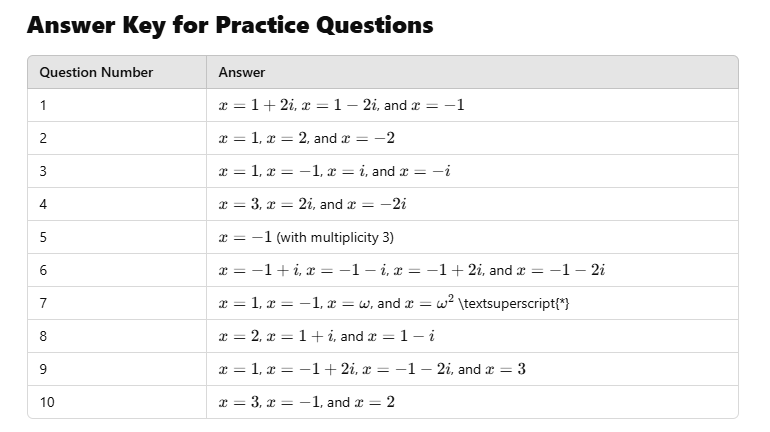
Practice Questions
- x^3 - 2x + 5 = 0
- x^4 - 2x^2 + 1 = 0
- x^2 - 2 = 0
- x^5 + x^4 - x - 1 = 0
- x^3 + 3x^2 + 3x + 1 = 0
- x^4 + 2x^3 + 3x^2 + 4x + 5 = 0
- x^6 - 1 = 0
- x^3 - x^2 - 2x + 2 = 0
- x^4 - 4x + 3 = 0
- 2x^3 - 3x^2 - 11x + 6 = 0
Applications of the Fundamental Theorem of Algebra
The Fundamental Theorem of Algebra isn't just theoretical; it has many practical uses.
- Engineering: Engineers use polynomial equations to model systems and solve for important parameters. For example, in control systems, they solve characteristic equations to ensure system stability.
- Computer Science: In computer graphics, algorithms for rendering images and animations involve solving polynomial equations to determine shapes and movements.
- Physics: Physical phenomena like wave behaviors and oscillations are described using polynomials. The theorem ensures that the equations modeling these behaviors have solutions, aiding in analysis and prediction.
Read more:
Conclusion
The Fundamental Theorem of Algebra is a fundamental principle that ensures every polynomial equation has a solution in the complex numbers. This theorem bridges different areas of mathematics and has numerous practical applications in science and engineering. By understanding and applying the Fundamental Theorem of Algebra, mathematicians and professionals can solve complex equations and advance their fields with confidence.
Embracing this theorem not only enhances your mathematical knowledge but also equips you with the tools to tackle real-world problems effectively. Whether you're a student, educator, or professional, the Fundamental Theorem of Algebra remains an essential part of your mathematical toolkit.