POTD 19 October: Level Of Nodes
Given an integer X and an undirected acyclic graph with V nodes, labeled from 0 to V-1, and E edges, find the level of the node labeled as X.
Level: It is the minimum number of edges you must travel from node 0 to some target.
If there doesn't exist such a node that is labeled as X, return -1.
Example:
Input: V = 5, Edges = {{0, 1}, {0, 2}, {1, 3}, {2, 4}}, X = 3
Output: 2
Explanation: Starting from vertex 0, at level 0 we have node 0, at level 1 we have nodes 1 and 2 and at level 2 we have nodes 3 and 4. So the answer is 2
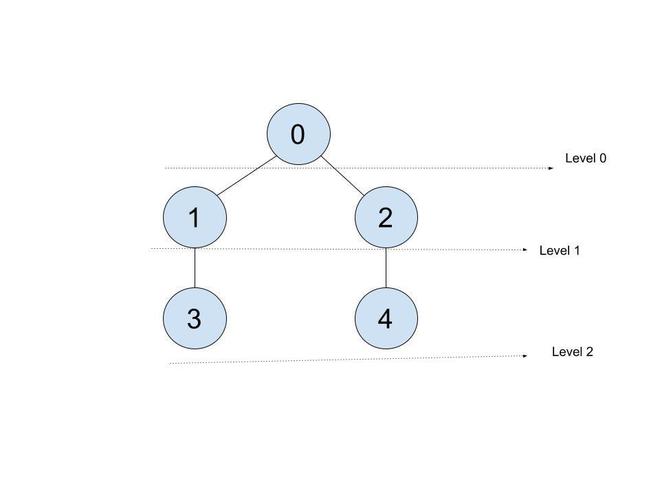
Input: V = 5, Edges = {{0, 1}, {0, 2}, {1, 3}, {2, 4}}, X = 5
Output: -1
Explanation: Vertex 5 is not present in the given graph so answer is -1
-660.jpg)
The given problem can be solved with the help of level order traversal. We can perform a BFS traversal in order to find the level of the given vertex
Follow the steps mentioned below to implement the idea:
- Find the maximum vertex of the graph and store it in a variable (say maxVertex).
- create adjacency list adj[] of size maxVertex+1.
- Check if X is present or not, if not then return -1.
- To traverse the graph, create a queue for level order traversal.
- Push vertex 0 in a queue, and set a counter level to 0.
- Create a visited array of size maxVertex+1 to mark the visited nodes.
- Start BFS traversal if the value of X is found in front of the queue then return the level.
- Keep popping nodes from the queue till it becomes empty and increment the counter level
- In one iteration, push all the unvisited nodes in the queue connected with the current node
- Increment the level variable to jump to the next level.
Below is the implementation of the above approach.
C++
class Solution {
public:
    int bfs(vector<int> adj[], int V, int vis[],
            int level[], int X)
    {
        if (X >= V)
            return -1;

        // storing 0 or first vertex in x.
        int x = 0;

        // creating a queue and pushing x into it.
        queue<int> q;
        q.push(x);

        // marking x as visited and its level will be 0.
        vis[x] = 1;
        level[x] = 0;

        while (!q.empty()) {
            // storing first element of queue and popping
            // it.
            int curr = q.front();
            q.pop();

            // traversing adjacent vertices of current
            // vertex.
            for (int i : adj[curr]) {
                // if vertex is not visited, we push it in
                // the queue, mark it as visited and store
                // its level.
                if (!vis[i]) {
                    q.push(i);
                    level[i] = level[curr] + 1;
                    vis[i] = 1;
                }
            }
        }
        // returning level of node X.
        return level[X];
    }

    // Function to find the level of node X.
    int nodeLevel(int V, vector<int> adj[], int X)
    {
        // arrays to store level of each node and to mark
        // nodes as visited.
        int vis[V] = { 0 }, level[V];
        for (int i = 0; i < V; i++) {
            level[i] = -1;
        }
        return bfs(adj, V, vis, level, X);
    }
};
class Solution {
    public int bfs(ArrayList<ArrayList<Integer> > adj,
                   int V, int[] vis, int[] level, int X)
    {
        if (X >= V)
            return -1;

        // Storing 0 or the first vertex in x.
        int x = 0;

        // Creating a queue and pushing x into it.
        Queue<Integer> q = new LinkedList<>();
        q.add(x);

        // Marking x as visited, and its level will be 0.
        vis[x] = 1;
        level[x] = 0;

        while (!q.isEmpty()) {
            // Storing the first element of the queue and
            // popping it.
            int curr = q.poll();

            // Traversing adjacent vertices of the current
            // vertex.
            for (int i : adj.get(curr)) {
                // If the vertex is not visited, we push it
                // in the queue, mark it as visited, and
                // store its level.
                if (vis[i] == 0) {
                    q.add(i);
                    level[i] = level[curr] + 1;
                    vis[i] = 1;
                }
            }
        }
        // Returning the level of node X.
        return level[X];
    }

    // Function to find the level of node X.
    public int nodeLevel(int V,
                         ArrayList<ArrayList<Integer> > adj,
                         int X)
    {
        // Arrays to store the level of each node and to
        // mark nodes as visited.
        int[] vis = new int[V];
        int[] level = new int[V];
        for (int i = 0; i < V; i++) {
            level[i] = -1;
        }
        return bfs(adj, V, vis, level, X);
    }
};
from collections import deque


class Solution:
    def bfs(self, adj, V, vis, level, X):
        if X >= V:
            return -1

        # Storing 0 or the first vertex in x.
        x = 0

        # Creating a queue and pushing x into it.
        q = deque()
        q.append(x)

        # Marking x as visited, and its level will be 0.
        vis[x] = 1
        level[x] = 0

        while q:
            # Storing the first element of the queue and popping it.
            curr = q.popleft()

            # Traversing adjacent vertices of the current vertex.
            for i in adj[curr]:
                # If the vertex is not visited, we push it in the queue, mark
                # it as visited, and store its level.
                if vis[i] == 0:
                    q.append(i)
                    level[i] = level[curr] + 1
                    vis[i] = 1

        # Returning the level of node X.
        return level[X]

    # Function to find the level of node X.
    def nodeLevel(self, V, adj, X):
        # Lists to store the level of each node and to mark nodes as visited.
        vis = [0] * V
        level = [-1] * V

        return self.bfs(adj, V, vis, level, X)
Time Complexity: O(V + E) For traversing all of the nodes.
Auxiliary Space: O(V) to store all the nodes in the queue.