Insert node into the middle of the linked list
Last Updated :
04 Sep, 2024
Given a linked list containing n nodes. The problem is to insert a new node with data x in the middle of the list. If n is even, then insert the new node after the (n/2)th node, else insert the new node after the (n+1)/2th node.
Examples:
Input: LinkedList = 1->2->4 , x = 3
Output: 1->2->3->4
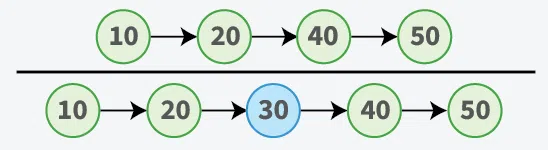
Input: LinkedList = 10->20->40->50 , x = 30
Output: 10->20->30->40->50
Explanation: The new element is inserted after the current middle element in the linked list and Hence, the output is 10->20->30->40->50.
[Expected Approach - 1] Using Two Traversal - O(n) Time and O(1) Space:
The idea is to first find the length of linked list and then insert node with value x after the half length of the linked list.
C++
// C++ implementation to insert node at the middle
// of the linked list
#include <iostream>
using namespace std;

class Node {
  public:
    int data;
    Node *next;
    Node(int x)
    {
        data = x;
        next = nullptr;
    }
};

// Function to insert a node at the middle
// of the linked list
Node *insertInMiddle(Node *head, int x) {

    // If the list is empty
    if (head == nullptr) {
        return new Node(x);
    }

    Node *newNode = new Node(x);
    Node *currNode = head;
    int len = 0;

    // Calculate the length of the linked list
    while (currNode != nullptr) {
        len++;
        currNode = currNode->next;
    }

    // Calculate the position to insert the new node
  	int mid;
    if (len % 2 == 0) {
        mid = len / 2;
    }
    else {
        mid = (len + 1) / 2;
    }

    currNode = head;

    // Move to the position before where
    // the new node will be inserted
    while (mid > 1) {
        currNode = currNode->next;
      	mid--;
    }

    // Insert the new node and adjust the links
    newNode->next = currNode->next;
    currNode->next = newNode;

    return head;
}

void printList(Node *head) {
  	Node* curr = head;
    while (curr != nullptr) {
        cout << curr->data << " ";
        curr = curr->next;
    }
    cout << endl;
}

int main() {
    // Creating the list 1->2->4->5
    Node *head = new Node(1);
    head->next = new Node(2);
    head->next->next = new Node(4);
    head->next->next->next = new Node(5);

    int x = 3;
    head = insertInMiddle(head, x);
    printList(head);

    return 0;
}
// C implementation to insert node at the middle
// of the linked list
#include <stdlib.h>

struct Node {
    int data;
    struct Node *next;
};

struct Node *createNode(int x);

// Function to insert a node at the middle
// of the linked list
struct Node *insertInMiddle(struct Node *head, int x) {
    if (head == NULL) {
        return createNode(x);
    }

    struct Node *newNode = createNode(x);
    struct Node *currNode = head;
    int len = 0;

    // Calculate the length of the linked list
    while (currNode != NULL) {
        len++;
        currNode = currNode->next;
    }

    int mid = (len % 2 == 0) ? len / 2 : (len + 1) / 2;
    currNode = head;

    // Move to the position before
    // where the new node will be inserted
    while (mid > 1) {
        currNode = currNode->next;
      	mid--;
    }

    // Insert the new node and adjust the links
    newNode->next = currNode->next;
    currNode->next = newNode;

    return head;
}

void printList(struct Node* head) {
    struct Node* curr = head;
    while (curr != NULL) {
        printf("%d ", curr->data);
        curr = curr->next;
    }
    printf("\n");
}

struct Node* createNode(int x) {
    struct Node* newNode =
      (struct Node*)malloc(sizeof(struct Node));
    newNode->data = x;
    newNode->next = NULL;
    return newNode;
}
int main() {

    // Creating the list 1->2->4->5
    struct Node *head = createNode(1);
    head->next = createNode(2);
    head->next->next = createNode(4);
    head->next->next->next = createNode(5);

    int x = 3;
    head = insertInMiddle(head, x);
    printList(head);

    return 0;
}
// Java implementation to insert node
// at the middle of the linked list

class Node {
    int data;
    Node next;

    Node(int x){
        data = x;
        next = null;
    }
}

class GfG {

    // Function to insert a node at
    // the middle of the linked list
    static Node insertInMiddle(Node head, int x){
        if (head == null) {
            return new Node(x);
        }

        Node newNode = new Node(x);
        Node currNode = head;
        int len = 0;

        // Calculate the length of the linked list
        while (currNode != null) {
            len++;
            currNode = currNode.next;
        }

        // Determine the middle position
        int count
            = (len % 2 == 0) ? (len / 2) : (len + 1) / 2;
        currNode = head;

        // Traverse to the middle node
        while (count-- > 1) {
            currNode = currNode.next;
        }

        // Insert the new node in the middle
        newNode.next = currNode.next;
        currNode.next = newNode;

        return head;
    }

    static void printList(Node head)
    {
        Node curr = head;
        while (curr != null) {
            System.out.print(curr.data + " ");
            curr = curr.next;
        }
        System.out.println();
    }

    public static void main(String[] args)
    {
        // Creating the list 1->2->4->5
        Node head = new Node(1);
        head.next = new Node(2);
        head.next.next = new Node(4);
        head.next.next.next = new Node(5);

        int x = 3;
        head = insertInMiddle(head, x);
        printList(head);
    }
}
# Python3 implementation to insert node
# at the middle of a linked list
class Node:
    def __init__(self, data):
        self.data = data
        self.next = None

# Function to insert a node at the
# middle of the linked list
def insertInMiddle(head, x):
    if head is None:
        return Node(x)

    new_node = Node(x)
    curr_node = head
    length = 0

    # Calculate the length of the linked list
    while curr_node is not None:
        length += 1
        curr_node = curr_node.next

    mid = length // 2 if length % 2 == 0 else (length + 1) // 2
    curr_node = head

    # Move to the position before
    # where the new node will be inserted
    while mid > 1:
        curr_node = curr_node.next
        mid -= 1

    # Insert the new node and adjust the links
    new_node.next = curr_node.next
    curr_node.next = new_node

    return head

def print_list(head):
    curr = head
    while curr is not None:
        print(curr.data, end=" ")
        curr = curr.next
    print()

if __name__ == "__main__":

    # Creating the list 1->2->4->5
    head = Node(1)
    head.next = Node(2)
    head.next.next = Node(4)
    head.next.next.next = Node(5)

    x = 3
    head = insertInMiddle(head, x)
    print_list(head)
// C# implementation to insert node
// at the middle of the linked list
using System;

class Node {
    public int data;
    public Node next;

    public Node(int x){
        data = x;
        next = null;
    }
}

class GfG {

    // Function to insert a node at the middle of the linked
    // list
    static Node insertInMiddle(Node head, int x)
    {
        if (head == null) {
            return new Node(x);
        }

        Node newNode = new Node(x);
        Node currNode = head;
        int len = 0;

        // Calculate the length of the linked list
        while (currNode != null) {
            len++;
            currNode = currNode.next;
        }

        // Determine the middle position
        int count
            = (len % 2 == 0) ? (len / 2) : (len + 1) / 2;
        currNode = head;

        // Traverse to the middle node
        while (count-- > 1) {
            currNode = currNode.next;
        }

        // Insert the new node in the middle
        newNode.next = currNode.next;
        currNode.next = newNode;

        return head;
    }

    static void printList(Node head)
    {
        Node curr = head;
        while (curr != null) {
            Console.Write(curr.data + " ");
            curr = curr.next;
        }
        Console.WriteLine();
    }

    public static void Main(string[] args)
    {
        // Creating the list 1->2->4->5
        Node head = new Node(1);
        head.next = new Node(2);
        head.next.next = new Node(4);
        head.next.next.next = new Node(5);

        int x = 3;
        head = insertInMiddle(head, x);
        printList(head);
    }
}
// Javascript implementation to insert node
// at the middle of the linked list

class Node {
    constructor(data) {
        this.data = data;
        this.next = null;
    }
}

// Function to insert a node
// at the middle of the linked list
function insertInMiddle(head, x) {
    if (head === null) {
        return new Node(x);
    }

    let newNode = new Node(x);
    let currNode = head;
    let length = 0;

    // Calculate the length of the linked list
    while (currNode !== null) {
        length++;
        currNode = currNode.next;
    }

    let mid = (length % 2 === 0) ? length / 2
                                 : (length + 1) / 2;
    currNode = head;

    // Move to the position before
    // where the new node will be inserted
    while (mid-- > 1) {
        currNode = currNode.next;
    }

    // Insert the new node and adjust the links
    newNode.next = currNode.next;
    currNode.next = newNode;

    return head;
}

function printList(head) {
    let curr = head;
    while (curr !== null) {
        process.stdout.write(curr.data + " ");
        curr = curr.next;
    }
    console.log();
}

// Creating the list 1->2->4->5
let head = new Node(1);
head.next = new Node(2);
head.next.next = new Node(4);
head.next.next.next = new Node(5);

let x = 3;
head = insertInMiddle(head, x);
printList(head);
Time Complexity: O(n), where n is the number of nodes in the linked list.
Auxiliary Space: O(1)
[Expected Approach - 2] Using Single Traversal - O(n) Time and O(1) Space:
The idea is based on the tortoise and hare algorithm which uses two pointers, slow_ptr and fast_ptr to traverse the list. Here, slow_ptr moves one step at a time while fast moves two steps. When fast_ptr reaches the end or NULL then slow_ptr will point to the middle of the linked list. In this specific problem, our task is to insert a new node after the middle of the list. we initialize the fast_ptr to head->next (one node ahead to slow_ptr) then when the fast reaches at end or NULL then slow_ptr pointer will points just before where the insertion should occur. Now, we can insert the new node after slow_ptr.
Below is the working of above algorithm:
Code Implementation:
C++
// C++ implementation to insert node at the middle
// of the linked list
#include <iostream>
using namespace std;

class Node {
  public:
    int data;
    Node *next;
    Node(int x) {
        data = x;
        next = nullptr;
    }
};

// Function to insert a node
// at the middle of the linked list
Node *insertInMiddle(Node *head, int x) {

    // If the list is empty
    if (head == nullptr) {
        return new Node(x);
    }
    else {

        // Create a new node
        Node *newNode = new Node(x);

        // Assign values to the slow and fast pointers
        Node *slow = head;
        Node *fast = head->next;

        // Move slow and fast pointers to find the middle
        while (fast && fast->next) {
            slow = slow->next;
            fast = fast->next->next;
        }

        // Insert the newNode and adjust the links
        newNode->next = slow->next;
        slow->next = newNode;

        return head;
    }
}

void printList(Node *head) {
  	Node* curr = head;
    while (curr != nullptr) {
        cout << curr->data << " ";
        curr = curr->next;
    }
    cout << endl;
}

int main() {

    // Creating the list 1->2->4->5
    Node *head = new Node(1);
    head->next = new Node(2);
    head->next->next = new Node(4);
    head->next->next->next = new Node(5);

    int x = 3;
    head = insertInMiddle(head, x);
    printList(head);

    return 0;
}
// C implementation to insert node at the middle
// of the linked list
#include <stdlib.h>

struct Node {
    int data;
    struct Node *next;
};

struct Node *createNode(int x);

// Function to insert a node
// at the middle of the linked list
struct Node *insertInMiddle(struct Node *head, int x) {

    // If the list is empty
    if (head == NULL) {
        return createNode(x);
    }
    else {

        // Create a new node
        struct Node *newNode = createNode(x);

        // Assign values to the slow and fast pointers
        struct Node *slow = head;
        struct Node *fast = head->next;

        // Move slow and fast pointers to find the middle
        while (fast && fast->next) {
            slow = slow->next;
            fast = fast->next->next;
        }

        // Insert the newNode and adjust the links
        newNode->next = slow->next;
        slow->next = newNode;

        return head;
    }
}

void printList(struct Node *head) {
    struct Node* curr = head;
    while (curr != NULL) {
        printf("%d ", curr->data);
        curr = curr->next;
    }
    printf("\n");
}

struct Node *createNode(int x) {
    struct Node *newNode =
      	(struct Node *)malloc(sizeof(struct Node));
    newNode->data = x;
    newNode->next = NULL;
    return newNode;
}

int main()
{
    // Creating the list 1->2->4->5
    struct Node *head = createNode(1);
    head->next = createNode(2);
    head->next->next = createNode(4);
    head->next->next->next = createNode(5);

    int x = 3;
    head = insertInMiddle(head, x);
    printList(head);

    return 0;
}
// Java implementation to insert node
// at the middle of the linked list

class Node {
    int data;
    Node next;
    Node(int x){
        data = x;
        next = null;
    }
}

class GfG {
    // Function to insert a node at the
    // middle of the linked list
    static Node insertInMiddle(Node head, int x)
    {

        // If the list is empty, create a new node as the
        // head
        if (head == null) {
            return new Node(x);
        }
        else {
            // Create a new node
            Node newNode = new Node(x);
            Node slow = head;
            Node fast = head.next;

            // Move slow and fast pointers to find the
            // middle
            while (fast != null && fast.next != null) {
                slow = slow.next;
                fast = fast.next.next;
            }

            // Insert the new node in the middle
            newNode.next = slow.next;
            slow.next = newNode;

            return head;
        }
    }
    static void printList(Node head)
    {
        Node curr = head;
        while (curr != null) {
            System.out.print(curr.data + " ");
            curr = curr.next;
        }
        System.out.println();
    }

    public static void main(String[] args)
    {

        // Creating the list 1->2->4->5
        Node head = new Node(1);
        head.next = new Node(2);
        head.next.next = new Node(4);
        head.next.next.next = new Node(5);

        int x = 3;
        head = insertInMiddle(head, x);
        printList(head);
    }
}
# Python3 implementation to insert node
# at the middle of a linked list
class Node:
    def __init__(self, data):
        self.data = data
        self.next = None

# Function to insert a node
# at the middle of the linked list
def insertInMiddle(head, x):

    # If the list is empty, create
    # a new node as the head
    if head is None:
        return Node(x)
    else:

        # Create a new node
        new_node = Node(x)
        slow = head
        fast = head.next

        # Move slow and fast pointers to find the middle
        while fast and fast.next:
            slow = slow.next
            fast = fast.next.next

        # Insert the new node in the middle
        new_node.next = slow.next
        slow.next = new_node
        return head

def print_list(head):
    curr = head
    while curr is not None:
        print(curr.data, end=" ")
        curr = curr.next
    print()


if __name__ == "__main__":

    # Creating the list 1->2->4->5
    head = Node(1)
    head.next = Node(2)
    head.next.next = Node(4)
    head.next.next.next = Node(5)

    x = 3
    head = insertInMiddle(head, x)
    print_list(head)
// C# implementation to insert node
// at the middle of the linked list
using System;

class Node {
    public int data;
    public Node next;

    public Node(int x){
        data = x;
        next = null;
    }
}

class GfG {

    // Function to insert a node at the middle of the linked
    // list
    static Node insertInMiddle(Node head, int x){

        // If the list is empty, create a new node as the
        // head
        if (head == null) {
            return new Node(x);
        }
        else {

            // Create a new node
            Node newNode = new Node(x);
            Node slow = head;
            Node fast = head.next;

            // Move slow and fast pointers to find the
            // middle
            while (fast != null && fast.next != null) {
                slow = slow.next;
                fast = fast.next.next;
            }

            // Insert the new node in the middle
            newNode.next = slow.next;
            slow.next = newNode;

            return head;
        }
    }

    static void printList(Node head){
        Node curr = head;
        while (curr != null) {
            Console.Write(curr.data + " ");
            curr = curr.next;
        }
        Console.WriteLine();
    }

    public static void Main(string[] args){

        // Creating the list 1->2->4->5
        Node head = new Node(1);
        head.next = new Node(2);
        head.next.next = new Node(4);
        head.next.next.next = new Node(5);

        int x = 3;
        head = insertInMiddle(head, x);
        printList(head);
    }
}
// Javascript implementation to insert node
// at the middle of the linked list

class Node {
    constructor(data) {
        this.data = data;
        this.next = null;
    }
}

// Function to insert a node
// at the middle of the linked list
function insertInMiddle(head, x)
{
    // If the list is empty, create
   	// a new node as the head
    if (head === null) {
        return new Node(x);
    }
    else {

        // Create a new node
        let newNode = new Node(x);
        let slow = head;
        let fast = head.next;

        // Move slow and fast pointers to find the middle
        while (fast !== null && fast.next !== null) {
            slow = slow.next;
            fast = fast.next.next;
        }

        // Insert the new node in the middle
        newNode.next = slow.next;
        slow.next = newNode;

        return head;
    }
}

function printList(head) {
    let currNode = head;
    while (currNode !== null) {
        process.stdout.write(currNode.data + " ");
        currNode = currNode.next;
    }
    console.log();
}

let head = new Node(1);
head.next = new Node(2);
head.next.next = new Node(4);
head.next.next.next = new Node(5);

let x = 3;
head = insertInMiddle(head, x);
printList(head);
Time Complexity: O(n), where n is the number of nodes in the linked list.
Auxiliary Space: O(1)
Explore
DSA Fundamentals
Data Structures
Algorithms
Advanced
Interview Preparation
Practice Problem