Find the number of paths of length K in a directed graph
Last Updated :
12 Jul, 2025
Given a directed, unweighted graph with N vertices and an integer K. The task is to find the number of paths of length K for each pair of vertices (u, v). Paths don't have to be simple i.e. vertices and edges can be visited any number of times in a single path.
The graph is represented as adjacency matrix where the value G[i][j] = 1 indicates that there is an edge from vertex i to vertex j and G[i][j] = 0 indicates no edge from i to j.
Examples:
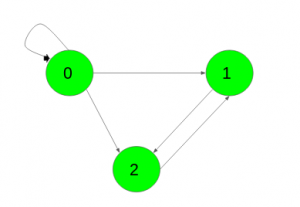
Input: K = 2,
Output:
1 2 2
0 1 0
0 0 1
Number of paths from 0 to 0 of length k is 1({0->0->0})
Number of paths from 0 to 1 of length k are 2({0->0->1}, {0->2->1})
Number of paths from 0 to 2 of length k are 2({0->0->2}, {0->1->2})
Number of paths from 1 to 1 of length k is 1({1->2->1})
Number of paths from 2 to 2 of length k is 1({2->1->2})
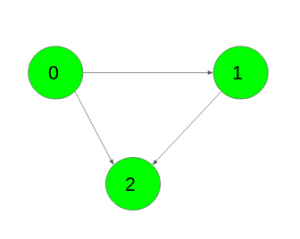
Input: K = 3,
Output:
1 0 0
0 1 0
0 0 1
Number of paths from 0 to 0 of length k is 1({0->1->2->0})
Number of paths from 1 to 1 of length k is 1({1->2->0->1})
Number of paths from 2 to 2 of length k is 1({2->1->0->2})
Prerequisite: Matrix exponentiation, Matrix multiplication
Approach: It is obvious that given adjacency matrix is the answer to the problem for the case k = 1. It contains the number of paths of length 1 between each pair of vertices.
Let's assume that the answer for some k is Matk and the answer for k + 1 is Matk + 1.
Matk + 1[i][j] = ?p = 1NMatk[i][p]*G[p][j]
It is easy to see that the formula computes nothing other than the product of the matrices Matk and G i.e. Matk + 1 = Matk * G
Thus, the solution of the problem can be represented as Matk = G * G * ... * G(k times) = Gk
Below is the implementation of the above approach:
C++
// C++ implementation of the approach
#include <bits/stdc++.h>
using namespace std;

#define N 3

// Function to multiply two matrices
void multiply(int a[][N], int b[][N], int res[][N])
{
    int mul[N][N];
    for (int i = 0; i < N; i++) {
        for (int j = 0; j < N; j++) {
            mul[i][j] = 0;
            for (int k = 0; k < N; k++)
                mul[i][j] += a[i][k] * b[k][j];
        }
    }

    // Storing the multiplication result in res[][]
    for (int i = 0; i < N; i++)
        for (int j = 0; j < N; j++)
            res[i][j] = mul[i][j];
}

// Function to compute G raised to the power n
void power(int G[N][N], int res[N][N], int n)
{

    // Base condition
    if (n == 1) {
        for (int i = 0; i < N; i++)
            for (int j = 0; j < N; j++)
                res[i][j] = G[i][j];
        return;
    }

    // Recursion call for first half
    power(G, res, n / 2);

    // Multiply two halves
    multiply(res, res, res);

    // If n is odd
    if (n % 2 != 0)
        multiply(res, G, res);
}

// Driver code
int main()
{
    int G[N][N] = { { 1, 1, 1 },
                    { 0, 0, 1 },
                    { 0, 1, 0 } };

    int k = 2, res[N][N];

    power(G, res, k);

    for (int i = 0; i < N; i++) {
        for (int j = 0; j < N; j++)
            cout << res[i][j] << " ";
        cout << "\n";
    }

    return 0;
}
// This Code is improved by cidacoder
// Java implementation of the approach
class GFG
{

static int N = 3;

// Function to multiply two matrices
static void multiply(int a[][], int b[][], int res[][])
{
    int [][]mul = new int[N][N];
    for (int i = 0; i < N; i++)
    {
        for (int j = 0; j < N; j++)
        {
            mul[i][j] = 0;
            for (int k = 0; k < N; k++)
                mul[i][j] += a[i][k] * b[k][j];
        }
    }

    // Storing the multiplication result in res[][]
    for (int i = 0; i < N; i++)
        for (int j = 0; j < N; j++)
            res[i][j] = mul[i][j];
}

// Function to compute G raised to the power n
static void power(int G[][], int res[][], int n)
{

    // Base condition
    if (n == 1) {
        for (int i = 0; i < N; i++)
            for (int j = 0; j < N; j++)
                res[i][j] = G[i][j];
        return;
    }

    // Recursion call for first half
    power(G, res, n / 2);

    multiply(res, res, res);

    // If n is odd
    if (n % 2 != 0)
        multiply(res, G, res);
}

// Driver code
public static void main(String[] args)
{
    int G[][] = { { 1, 1, 1 },
                    { 0, 0, 1 },
                    { 0, 1, 0 } };

    int k = 2;
    int [][]res = new int[N][N];

    power(G, res, k);

    for (int i = 0; i < N; i++)
    {
        for (int j = 0; j < N; j++)
            System.out.print(res[i][j] + " ");
        System.out.println("");
    }
}
}

// This code is contributed by 29AjayKumar
// This Code is improved by cidacoder
# Python3 implementation of the approach

import numpy as np

N = 3

# Function to multiply two matrices
def multiply(a, b, res) :

    mul = np.zeros((N,N));

    for i in range(N) :
        for j in range(N) :
            mul[i][j] = 0;
            for k in range(N) :
                mul[i][j] += a[i][k] * b[k][j];

    # Storing the multiplication result in res[][]
    for i in range(N) :
        for j in range(N) :
            res[i][j] = mul[i][j];


# Function to compute G raised to the power n
def power(G, res, n) :

    # Base condition
    if (n == 1) :
        for i in range(N) :
            for j in range(N) :
                res[i][j] = G[i][j];
        return;

    # Recursion call for first half
    power(G, res, n // 2);

    # Multiply two halves
    multiply(res, res, res);

    # If n is odd
    if (n % 2 != 0) :
        multiply(res, G, res);

# Driver code
if __name__ == "__main__" :

    G = [
        [ 1, 1, 1 ],
        [ 0, 0, 1 ],
        [ 0, 1, 0 ]
        ];

    k = 2;
    res = np.zeros((N,N));

    power(G, res, k);

    for i in range(N) :
        for j in range(N) :
            print(res[i][j],end = " ");

        print()

# This code is contributed by AnkitRai01
# This Code is improved by cidacoder
// C# implementation of the approach
using System;

class GFG
{

static int N = 3;

// Function to multiply two matrices
static void multiply(int [,]a, int [,]b, int [,]res)
{
    int [,]mul = new int[N,N];
    for (int i = 0; i < N; i++)
    {
        for (int j = 0; j < N; j++)
        {
            mul[i,j] = 0;
            for (int k = 0; k < N; k++)
                mul[i,j] += a[i,k] * b[k,j];
        }
    }

    // Storing the multiplication result in res[][]
    for (int i = 0; i < N; i++)
        for (int j = 0; j < N; j++)
            res[i,j] = mul[i,j];
}

// Function to compute G raised to the power n
static void power(int [,]G, int [,]res, int n)
{

    // Base condition
    if (n == 1) {
        for (int i = 0; i < N; i++)
            for (int j = 0; j < N; j++)
                res[i,j] = G[i,j];
        return;
    }

    // Recursion call for first half
    power(G, res, n / 2);

    // Multiply two halves
    multiply(res, res, res);

    // If n is odd
    if (n % 2 != 0)
        multiply(res, G, res);
}

// Driver code
public static void Main()
{
    int [,]G = { { 1, 1, 1 },
                    { 0, 0, 1 },
                    { 0, 1, 0 } };

    int k = 2;
    int [,]res = new int[N,N];

    power(G, res, k);

    for (int i = 0; i < N; i++)
    {
        for (int j = 0; j < N; j++)
            Console.Write(res[i,j] + " ");
        Console.WriteLine("");
    }
}
}

// This code is contributed by anuj_67..
// This code is improved by cidacoder
<script>
    // Javascript implementation of the approach

    let N = 3;

    // Function to multiply two matrices
    function multiply(a, b, res)
    {
        let mul = new Array(N);
        for (let i = 0; i < N; i++)
        {
            mul[i] = new Array(N);
            for (let j = 0; j < N; j++)
            {
                mul[i][j] = 0;
                for (let k = 0; k < N; k++)
                    mul[i][j] += a[i][k] * b[k][j];
            }
        }

        // Storing the multiplication result in res[][]
        for (let i = 0; i < N; i++)
            for (let j = 0; j < N; j++)
                res[i][j] = mul[i][j];
    }

    // Function to compute G raised to the power n
    function power(G, res, n)
    {

        // Base condition
        if (n == 1) {
            for (let i = 0; i < N; i++)
                for (let j = 0; j < N; j++)
                    res[i][j] = G[i][j];
            return;
        }

        // Recursion call for first half
        power(G, res, parseInt(n / 2, 10));

        // Multiply two halves
        multiply(res, res, res);

        // If n is odd
        if (n % 2 != 0)
            multiply(res, G, res);
    }

    let G = [ [ 1, 1, 1 ],
             [ 0, 0, 1 ],
             [ 0, 1, 0 ] ];

    let k = 2;
    let res = new Array(N);
    for (let i = 0; i < N; i++)
    {
        res[i] = new Array(N);
        for (let j = 0; j < N; j++)
        {
            res[i][j] = 0;
        }
    }

    power(G, res, k);

    for (let i = 0; i < N; i++)
    {
        for (let j = 0; j < N; j++)
            document.write(res[i][j] + " ");
        document.write("</br>");
    }

</script>
Output: 1 2 2
0 1 0
0 0 1
Time Complexity -
Since we have to multiply the adjacency matrix log(k) times (using matrix exponentiation), the time complexity of the algorithm is O((|V|^3)*log(k)), where V is the number of vertices, and k is the length of the path.
Explore
DSA Fundamentals
Data Structures
Algorithms
Advanced
Interview Preparation
Practice Problem