
A supercomputer exists as a high-performance computing system that delivers quick and precise solutions to complex problems beyond standard computer capabilities. The processing capabilities of supercomputers enable them to handle millions of tasks simultaneously.
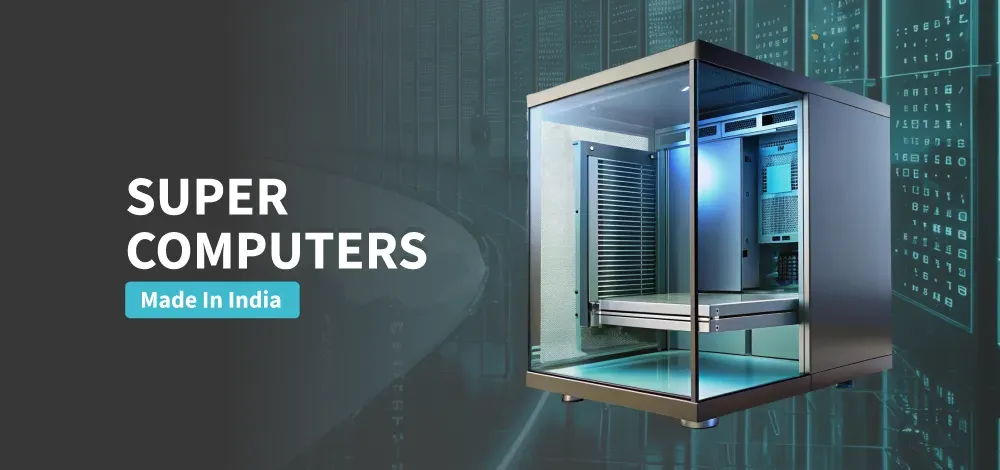
The utilization of supercomputers occurs in weather prediction systems, space missions, scientific investigations, and high-data processing tasks. Supercomputers consist of multiple processors connected to one another in a vast network, which forms systems that often occupy the space of an entire room. The difference between a regular computer and a supercomputer resembles the distinction between a bicycle and a jet plane because the latter functions at high speeds while performing intense tasks.
The need for a Supercomputer
- In India, the necessity for a supercomputer is required for improving the monsoon forecasting capability. In the mid-1980's India desperately needed this as they had a hard time getting one from the US. So what India needed to settle was on the second and third best available (CRAY XMP-14). This type of computer was offered for sale, so the CRAY XMP-14 was bought by India, as there was no other choice instead to get this.
- The US govt refused to oblige when a second supercomputer was asked by the IISC (Indian Institute of Science Bangalore) so this incident made Indian Computer Scientist think on the issue and wake up from their slumber for going ahead and building up one by themselves only.
- Now the phase has come that India can boast of indigenous models of supercomputers which can do almost the equal jobs as the imported one and even cost only a fraction of it this all happens because of the well-orchestrated effort by a dedicated team, so we all thank that for their work and efforts they made to make India into the list for developing supercomputers like the other countries.
Importance of Supercomputers in Modern India
Supercomputers play a key role in solving complex problems quickly and accurately. In India, they are being used across different sectors to boost research, security, and development:
- Weather Forecasting: Supercomputers help predict monsoons, cyclones, and floods with better accuracy, which is crucial for agriculture and disaster management.
- Space Research (ISRO): ISRO uses them for satellite design, mission simulations, and processing huge volumes of space data, improving the success rate of space missions.
- Defense: The military uses supercomputers to simulate battlefield scenarios, design advanced weapons, and ensure cybersecurity.
- Climate Modeling: These machines simulate long-term climate changes and environmental patterns, helping scientists understand global warming and make informed policy decisions.
- Drug Discovery: Supercomputers speed up the process of analyzing how different chemicals affect the body, which helps in developing new medicines faster.
- Artificial Intelligence: AI systems need a lot of computing power to learn from data. Supercomputers help train large AI models used in everything from language translation to medical diagnostics.
By powering these critical sectors, supercomputers are helping India advance technologically and stay competitive on the global stage.
Supercomputer History
- The first supercomputer came up among was the one called Flosolver, this was the Bangalore based National Aeronautical Laboratory now we call this as National Aerospace Laboratories NAL.
- At the Centre for Atmospheric Science of the Indian Institute Of Science (IISC), Bangalore the latest version of the Flosolver system came known as Flosolver Mk3.
- For India Metrological Department the Flosolver Mk3 is about half as powerful as the Cray XMP purchased according to the designers, but it costs only a tenth of the cost of a Cray machine.
- Decided to have a supercomputer when the Defense Research and Development Organization. The other discovered was the one called PACE (Processor for Aerodynamic Computation and Evaluation), which is developed by Hyderabad-based Advanced Numerical Research and Analysis Group (ANURAG).
- CRAY-level speed is achieved by the PACE the speed of PACE is around 100 megaflops and it does not need special cooling arrangements like the one we call CRAY even it is big even we can say the very big advantage of PACE.
PARAM Supercomputer -Made In India
- In the world market, the Indian supercomputer that makes a mark was the multipurpose high-speed machine we called in a name PARAM, Which is developed by the Pune based Centre for development of Advanced Computing (C-DAC).
- The peak performance of a whopping one gigaflops is in PARAM 8000 with 256 processing nods which have a comparison to some of most advanced such machines available yet at Rs 2 crore in 1991, this was the cheapest supercomputers available in the world.
- With the development of PARAM 8600 and PARAM 9000 subsequently, the PARAM 8000 was upgraded and the latest in the PARAM series is the PARAM PADMA launched in 2003.
- The 1 trillion processes per second the PARAM PADMA has 1 teraflops of power such power has previously only been available to countries such as the USA and Japan.
- The storage capacity is 5 terabytes which can be increased by 22 terabytes and developed at the cost of $10 million in PARAM PADMA. India Plans to market the PARAM PADMA internationally.
- The earlier version of supercomputer PARAM 10,000 with 100 gigaflops(floating-point operations per second) memory is been sold by 8 countries including Germany, Russia, Singapore, and Canada.
Comparison with Global Supercomputing Powers
India has made impressive progress in supercomputing, but still lags behind global leaders like the USA, China, and Japan in terms of overall power and numbers.
- USA: Home to some of the world's fastest supercomputers like Frontier and Summit. The U.S. leads in high-performance computing for defense, research, and AI.
- China: Has the largest number of systems on the global Top500 list. Known for building extremely powerful machines like Sunway TaihuLight and investing heavily in homegrown technology.
- Japan: Known for Fugaku, once the world's fastest supercomputer. Japan focuses on disaster prevention, healthcare research, and scientific innovation.
- India: Though not at the top, India has built powerful indigenous systems like PARAM Siddhi-AI, which was once ranked in the Top 100 globally. India is strengthening its position through the National Supercomputing Mission, aiming to build over 70 high-performance systems across the country.
In short, while India is catching up, it still has a way to go before it can match the scale and speed of global supercomputing giants.
Must Read
Conclusion
Supercomputers stand as fundamental instruments which execute intricate issues at an accelerated pace while delivering highly precise results compared to standard computing systems. India made substantial progress towards technological independence starting from its initial dependence on foreign technology by developing the powerful PARAM machines. Modern supercomputers play essential roles in key industries such as weather prediction and defense systems and space exploration and healthcare services. Through its National Supercomputing Mission India moves toward the digital future by progressively minimizing its technological lag behind the USA, China and Japan.